






"Integral I"
Curating: Ileana Tounta, Dimitrios Antonitsis, Galini Lazani

Tel +30 210 6439466 Fax +30 210 6442852 e-mail:This email address is being protected from spambots. You need JavaScript enabled to view it.



Alexis Akrithakis, Dimitrios Antonitsis, Eugenia Apostolou, Daniil, Martha Dimitropoulou, Makis Theofylaktopoulos, Costas Coulentianos, Eva Mitala, Frini Mouzakitou, Manolis Baboussis, loanna Pantazopoulou, Harry Patramanis, Panos Famelis, Katerina Christidi
Curating: Ileana Tounta, Dimitrios Antonitsis, Galini Lazani
ILEANA TOUNTA CONTEMPORARY ART CENTRE
48 Armatolon-Klefton st. 114 71, Athens - GR
Tel +30 210 6439466 Fax +30 210 6442852 e-mail:
04.04 > 03.06, 2017
|
|
|
2010 was the year the crisis began in Greece. After the initial shock, some of us, with greater composure, started to envision the benefits we could obtain as a society. After decades of greed, futility and unrestricted capitalism, the financial crisis could serve as a chance to return to waning values and see the world in its “real” dimensions. Of course, in our minds, the crisis would have been a temporary situation. Nowadays, after 7 years of poverty, unemployment and insecurity –not only in Greece, but in the entirety of Europe- after the waves of immigrants and refugees, any optimism has been erased. We can no longer talk about economic crises of individual countries, but about a crisis which is worldwide, cultural and ethical.
Europe, built upon the ruins of World War II, appears to be rattled by a long-lasting recession, which led to a boundless populism and as a result, the flourishing of phobic extreme right political parties, who came to claim governance even in deeply democratic countries. The exceptionally speedy development of internet and the social media served as a means of public speech for each and every one. Among the benefits which are offered by technology, there was, as a collateral damage, the ease with which these phenomena spread, causing even the misinformation of citizens, through hoax news. “The politics of fear and introversion tends to replace the politics of logic” (Baruch Spinoza). Our fear is no longer personal, nor regional, but existential.
The purpose of this exhibition is to imprint all these with artists of various generations, whose artworks create the atmosphere of a dark period and ominous perspective.
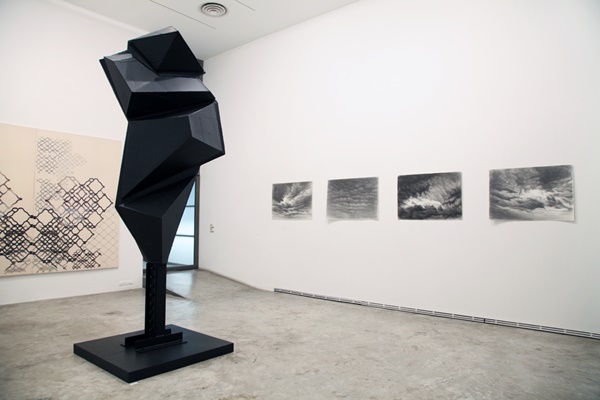
Upon entering the exhibition area, the visitor receives a sense of entrainment in an unpleasant, threatening environment. The Great Madman, the imposing sculpture of metal by Costas Coulentianos, the Black Skies on Panos Famelis’ drawings, the malformed, unfamiliar forms by Makis Theofylaktopoulos and Katerina Christidi, as well as the Silent Ways by Eugenia Apostolou, depict the effect that a dismal reality has on a person.
The immobile, “dangerous” flag by Martha Dimitropoulou and the photograph of a characteristic image of the Greek province by Manolis Baboussis, arouses the issue of state identity. The influence of the Greek identity can also be discerned by Daniil’s burlap cloth. By contrast, Alexis Akrithakis’ 1970-1980’s works, the suitcases, are a symbol of perpetual escape. Harry Patramanis’ video of the derelict airport Elliniko highlights this inevitable instinct of flight which every crisis causes, along with its dead end.
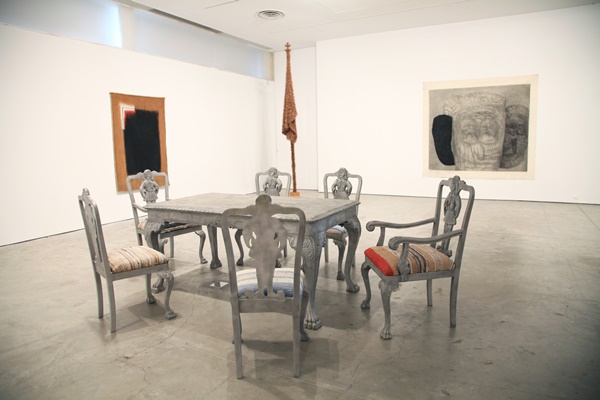
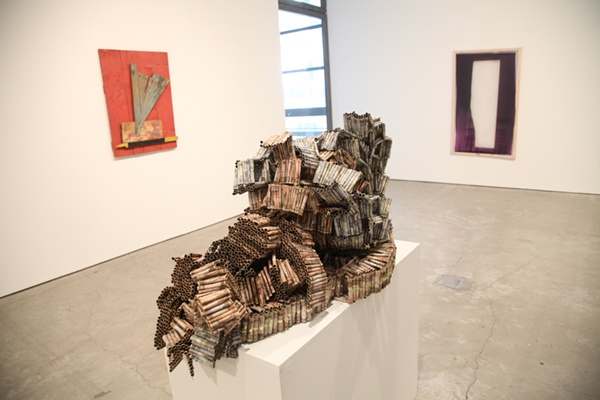
The dining table by Dimitrios Antonitsis, leftovers of a past life, refers to the first financial crisis of Greece, during the reign of king Otto. Equally comprehensible is the comment by Ioanna Pantazopoulou, about the devaluation of money as a value in general, through her sculpture of withdrawn banknotes from North Korea.
Eva Mitala’s silk-screens depict the contemporary image of the city. The off-gallery installation The Athénée Project, by Frini Mouzakitou, in the historical Arsakeio Arcade, marks the desolation of a central commercial Athenian avenue, such as Stadiou street, which links two historical city squares, the one of Omonoia sq. and Syntagma sq., with its shops closed and the shutters rolled down, reminiscent of a ghost town.
Europe, built upon the ruins of World War II, appears to be rattled by a long-lasting recession, which led to a boundless populism and as a result, the flourishing of phobic extreme right political parties, who came to claim governance even in deeply democratic countries. The exceptionally speedy development of internet and the social media served as a means of public speech for each and every one. Among the benefits which are offered by technology, there was, as a collateral damage, the ease with which these phenomena spread, causing even the misinformation of citizens, through hoax news. “The politics of fear and introversion tends to replace the politics of logic” (Baruch Spinoza). Our fear is no longer personal, nor regional, but existential.
The purpose of this exhibition is to imprint all these with artists of various generations, whose artworks create the atmosphere of a dark period and ominous perspective.
Upon entering the exhibition area, the visitor receives a sense of entrainment in an unpleasant, threatening environment. The Great Madman, the imposing sculpture of metal by Costas Coulentianos, the Black Skies on Panos Famelis’ drawings, the malformed, unfamiliar forms by Makis Theofylaktopoulos and Katerina Christidi, as well as the Silent Ways by Eugenia Apostolou, depict the effect that a dismal reality has on a person.
The immobile, “dangerous” flag by Martha Dimitropoulou and the photograph of a characteristic image of the Greek province by Manolis Baboussis, arouses the issue of state identity. The influence of the Greek identity can also be discerned by Daniil’s burlap cloth. By contrast, Alexis Akrithakis’ 1970-1980’s works, the suitcases, are a symbol of perpetual escape. Harry Patramanis’ video of the derelict airport Elliniko highlights this inevitable instinct of flight which every crisis causes, along with its dead end.
The dining table by Dimitrios Antonitsis, leftovers of a past life, refers to the first financial crisis of Greece, during the reign of king Otto. Equally comprehensible is the comment by Ioanna Pantazopoulou, about the devaluation of money as a value in general, through her sculpture of withdrawn banknotes from North Korea.
Eva Mitala’s silk-screens depict the contemporary image of the city. The off-gallery installation The Athénée Project, by Frini Mouzakitou, in the historical Arsakeio Arcade, marks the desolation of a central commercial Athenian avenue, such as Stadiou street, which links two historical city squares, the one of Omonoia sq. and Syntagma sq., with its shops closed and the shutters rolled down, reminiscent of a ghost town.
 Alexis Akrithakis |
Dimitrios Antonitsis |
Martha Dimitropoulou |
Makis Theofylaktopoulos |
Costas Coulentianos |
Manolis Baboussis |
|
Panos Famelis |
Katerina Christidi |
opening reception :
Thuesday 04/04, 19:30 - 22:30
mpefm
GREECE art press release
Visiting hours:
Tuesday to Friday 12:00 - 20:00
Saturday: 12:00 – 16:00
Download the QR code on this page and enter in your site, social networks or email

Saturday: 12:00 – 16:00
Download the QR code on this page and enter in your site, social networks or email