






"re-new"

17 Morrow Avenue Toronto, Canada M6R 2H9
416-538-8220 e-mail:This email address is being protected from spambots. You need JavaScript enabled to view it.



Stan Denniston
KORPER OLGA Gallery
17 Morrow Avenue Toronto, Canada M6R 2H9
416-538-8220 e-mail:
February 4 > 25, 2017
 Joe's Boat, 2016 stone, disposable cutlery, wood, twine, printer cable 13" x 13" x 13" |
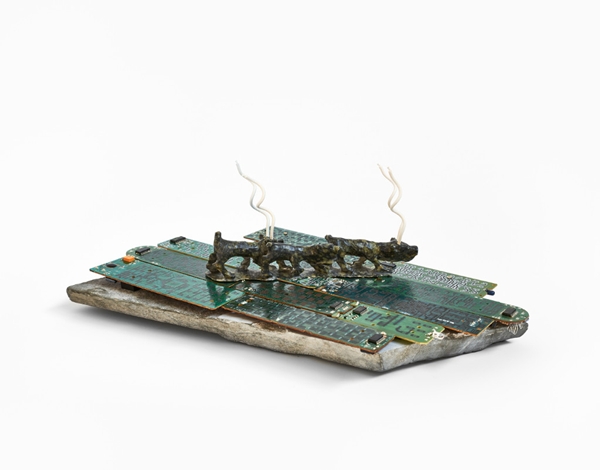 Remote Tundra, 2015 mixed media 6.25" x 17.25" x 9.5" |
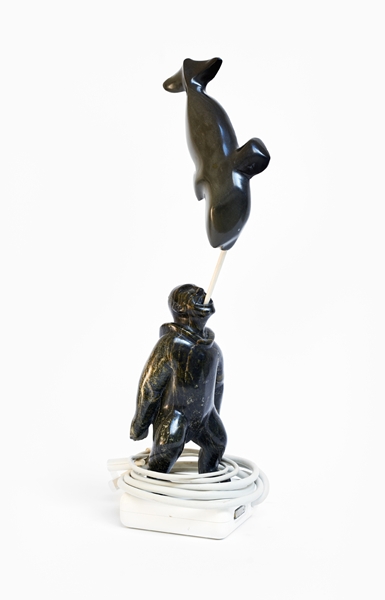 Exhale, 2014 mixed media 21" x 6.5" x 7" |
 Joe's Portage, 2016 stone, projector, swizzle sticks, wood, twine, printer cable 7" x 10" x 10" |
For over 35 years, Stan Denniston has served the Inuit art community as the go to restorer of sculpture. And over those decades he has accumulated an inventory of damaged and abandoned sculptures, elements, and fragments. It’s a unique position, that of the last repository of the unwanted. In the spirit of rescue, of reduce, re-use, recycle, he has collaged surplus sculpture, consumer electronics and household goods, and invoked autobiography with the inclusion his long treasured camera gear in the mash-up. These interventions contrast actual objects of his material world with the story-telling representations of the Inuit.
Following his first exhibition of mash-up sculptures, Denniston became the willing, but wary, recipient of a rush of other’s prized consumer cast-offs and yet more damaged sculpture.
“I sensed in this out-pouring more than just goodwill towards my project. I got a glimpse of people’s complicated relationship with excess and disposal. Getting rid of something is never simply an act of spatial displacement. Our possessions have entanglements. And, whereas consumption might be seen as a social activity, disposal is personal, private.”
These are new works from discarded material - including cannibalizing his own productive surplus (sculptures) - old things gaining new meanings. Of all the categories of consumer objects, such as tools, white goods (large electric appliances such as fridges, stoves etc.), communication devices, art objects are never meant for casual disposal. They are for ‘forever’. After all, art objects can appreciate in influence and value over time (and we all want to participate in that).
“I’m aware of the irony that that I’m making more objects while penning this plea for less. And I would never claim my practice of re-purposing objects as any solution to our deluge of garbage, but it can continue the conversation. Surely, as we develop an ethic of sustainability, disposal has to become the primary consideration of the (highly simplified) arc of production, consumption, disposal. Consumption should never be unencumbered.”
“I sensed in this out-pouring more than just goodwill towards my project. I got a glimpse of people’s complicated relationship with excess and disposal. Getting rid of something is never simply an act of spatial displacement. Our possessions have entanglements. And, whereas consumption might be seen as a social activity, disposal is personal, private.”
These are new works from discarded material - including cannibalizing his own productive surplus (sculptures) - old things gaining new meanings. Of all the categories of consumer objects, such as tools, white goods (large electric appliances such as fridges, stoves etc.), communication devices, art objects are never meant for casual disposal. They are for ‘forever’. After all, art objects can appreciate in influence and value over time (and we all want to participate in that).
“I’m aware of the irony that that I’m making more objects while penning this plea for less. And I would never claim my practice of re-purposing objects as any solution to our deluge of garbage, but it can continue the conversation. Surely, as we develop an ethic of sustainability, disposal has to become the primary consideration of the (highly simplified) arc of production, consumption, disposal. Consumption should never be unencumbered.”
Opening :
Saturday, February 4, 2-5 PM
mpefm
CANADA art press release
Opening hours :
Tuesday - Saturday 10am-6pm or by appointment
Download the QR code on this page and enter in your site, social networks or email

Download the QR code on this page and enter in your site, social networks or email