





Beatriz Cortez, Eddie Rodolfo Aparicio, Julie Tolentino

COMMONWEALTH AND COUNCIL
3006 West 7th Street Suite 220 Los Angeles, CA 90005 United States

Tel. 213 703 9077 e-mail:


Art Basel Miami Beach 2021
Miami Beach Convention Center 1901 Convention Center Drive Miami Beach, FL 33139+41 58 206 27 06 e-mail:
2 > 4 December, 2021
Booth N12
For Art Basel Miami Beach 2021, Commonwealth and Council presents new works by Beatriz Cortez, Eddie Rodolfo Aparicio, and Julie Tolentino. Each artist inscribes the ineffable vestiges of loss, perseverance, and joy wrought by histories of migration, survival, and queer existence. They mine sites of displacement and farewells, and of encounters with new possible lives, creating memorials, indexing oft-overlooked memories and materials of the land—soil, plants, human detritus, and our own ephemeral bodies. A trilling tree trunk, a shape-shifting assembly of mirror-faceted cubes, a rock that holds breath. In their midst, we encounter glimmers of solidarity across the realms of plant and animal, living and dead.
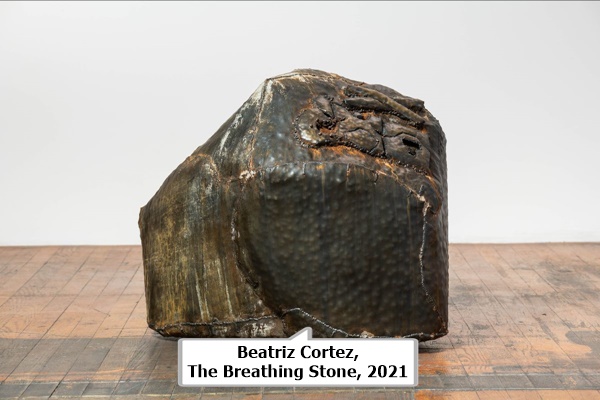
Plants, like humans, are networked beings—roots circulate resources and information in imperceptible, underground chatter. Salvadoran artist Beatriz Cortez upends this invisibility with steel reimaginations of root systems, inverted to resemble a brain stem or nervous system. Crowned with a tangle of grey matter, these sculptures posit Indigenous knowledge as not trod-upon foundation but vital and active components of knowledge and survival. After all, plants fundamentally enable all terrestrial life. Perhaps these plants continue to circulate the wisdom of those who preceded us through the mediums of soil and air. Roots function as plants' main way of communication, both internally and with other plants. The breath that we inhale carries missives from the plant and all its interconnected brethren. The Breathing Stone, a patinated steel boulder, holds Mayan glyphs whose aggregated meaning reads "The stone that manifests breathing for the people"—a tribute to human and non-human persistence, and to the unseen but no less crucial collaborations that facilitate life.
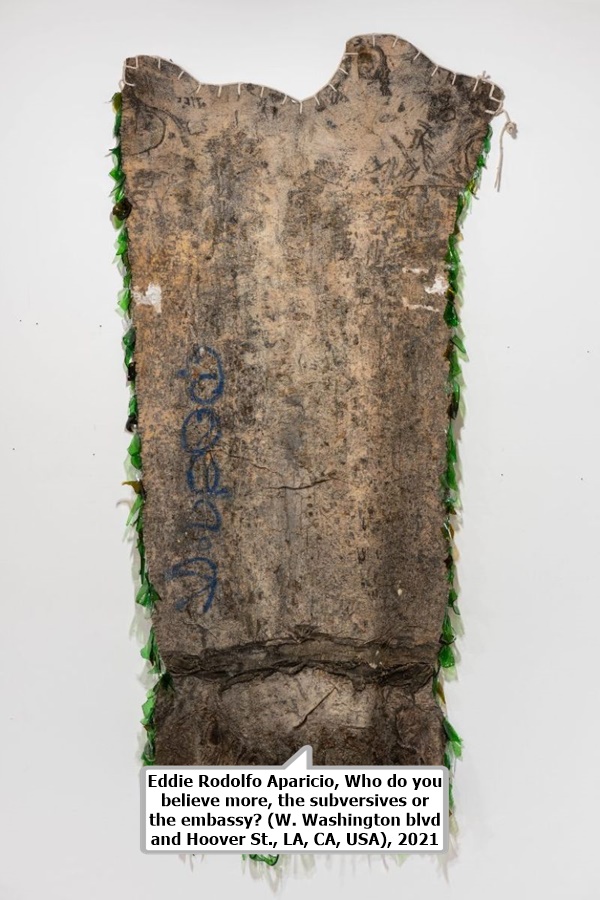
Eddie Rodolfo Aparicio positions trees as living witnesses and documents within an intimate portrait of the Central American diaspora. Aparicio has taken skin-like rubber casts from trees in the Pico-Union and Westlake neighborhoods of Los Angeles, home to a large Central American immigrant population. Backed with found and donated clothing and limned with glass shards in a gesture of protection, this patchworked and resilient body resembles that of the emigré community itself—taken apart, reconstituted. These trees act as markers of life and loss, holding in their surfaces markings from graffiti, carvings, and pollution—just as Cortez's unsealed steel, too, will gradually assume the tarnish and imprints of the air and those with whom it comes in contact. Many of the trees that Aparicio casts have been cut down, rendering his artworks tributes to a changing urban landscape and remembering the mass deforestation (with US assistance) of El Salvador during its civil war. The work acknowledges the shared histories of plants and people and attempts to realign the narrative of migration as a global and natural force.
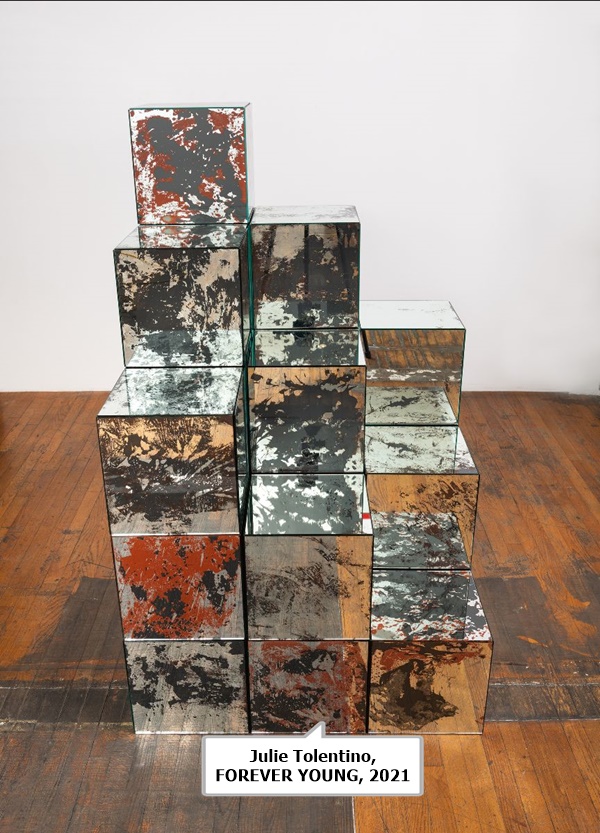
A mirrored glass cube splits apart into units: glittering metonyms; blood red and black abrasions stain their surfaces. Julie Tolentino takes a smoldering slurry of acid and a razor blade to the mirror glass, coaxing it to reveal the initials of those loved and lost. Each chemical wash is a testament of remembrance, conjuring the bodies and spirits taken by racialized violence and stigmatized illness. Spilling from their aggregated cube in ever-changing configurations, the confluence of mirrored boxes creates kaleidoscopic feedback loops of edges and vertices, recalling the mobility of grief. Karen Barad writes that "loss is not absence but a marked presence, or rather a marking that troubles the divide between absence and presence." The haunts, ghosting across the mirror, separate us from the familiarity of our reflections in a silent intercession. The marred reflections resist the mirror's seduction, its compulsion to merely echo its surroundings; rather it tampers with material reality to reveal a world shot through with loss, with the viewer as a sole, and forever-marked, survivor.
Plants, like humans, are networked beings—roots circulate resources and information in imperceptible, underground chatter. Salvadoran artist Beatriz Cortez upends this invisibility with steel reimaginations of root systems, inverted to resemble a brain stem or nervous system. Crowned with a tangle of grey matter, these sculptures posit Indigenous knowledge as not trod-upon foundation but vital and active components of knowledge and survival. After all, plants fundamentally enable all terrestrial life. Perhaps these plants continue to circulate the wisdom of those who preceded us through the mediums of soil and air. Roots function as plants' main way of communication, both internally and with other plants. The breath that we inhale carries missives from the plant and all its interconnected brethren. The Breathing Stone, a patinated steel boulder, holds Mayan glyphs whose aggregated meaning reads "The stone that manifests breathing for the people"—a tribute to human and non-human persistence, and to the unseen but no less crucial collaborations that facilitate life.
Eddie Rodolfo Aparicio positions trees as living witnesses and documents within an intimate portrait of the Central American diaspora. Aparicio has taken skin-like rubber casts from trees in the Pico-Union and Westlake neighborhoods of Los Angeles, home to a large Central American immigrant population. Backed with found and donated clothing and limned with glass shards in a gesture of protection, this patchworked and resilient body resembles that of the emigré community itself—taken apart, reconstituted. These trees act as markers of life and loss, holding in their surfaces markings from graffiti, carvings, and pollution—just as Cortez's unsealed steel, too, will gradually assume the tarnish and imprints of the air and those with whom it comes in contact. Many of the trees that Aparicio casts have been cut down, rendering his artworks tributes to a changing urban landscape and remembering the mass deforestation (with US assistance) of El Salvador during its civil war. The work acknowledges the shared histories of plants and people and attempts to realign the narrative of migration as a global and natural force.
A mirrored glass cube splits apart into units: glittering metonyms; blood red and black abrasions stain their surfaces. Julie Tolentino takes a smoldering slurry of acid and a razor blade to the mirror glass, coaxing it to reveal the initials of those loved and lost. Each chemical wash is a testament of remembrance, conjuring the bodies and spirits taken by racialized violence and stigmatized illness. Spilling from their aggregated cube in ever-changing configurations, the confluence of mirrored boxes creates kaleidoscopic feedback loops of edges and vertices, recalling the mobility of grief. Karen Barad writes that "loss is not absence but a marked presence, or rather a marking that troubles the divide between absence and presence." The haunts, ghosting across the mirror, separate us from the familiarity of our reflections in a silent intercession. The marred reflections resist the mirror's seduction, its compulsion to merely echo its surroundings; rather it tampers with material reality to reveal a world shot through with loss, with the viewer as a sole, and forever-marked, survivor.
 | Beatriz Cortez | |
| | Eddie Rodolfo Aparicio | |
| | Julie Tolentino | |
Private Days (by invitation only)
Tuesday, November 30, 2021, 11am to 8pm, First Choice VIP cardholders
Tuesday, November 30, 2021, 4pm to 8pm, Preview VIP cardholders
Wednesday, December 1, 2021, 11am to 8pm, First Choice and Preview VIP cardholders
Vernissage (by invitation only)
Wednesday, December 1, 2021, 4pm to 8pm
Tuesday, November 30, 2021, 11am to 8pm, First Choice VIP cardholders
Tuesday, November 30, 2021, 4pm to 8pm, Preview VIP cardholders
Wednesday, December 1, 2021, 11am to 8pm, First Choice and Preview VIP cardholders
Vernissage (by invitation only)
Wednesday, December 1, 2021, 4pm to 8pm
mpefm
USA fair art press release
Public days:
Thursday, December 2, 2021, 11am to 7pm
Friday, December 3, 2021, 11am to 7pm
Saturday, December 4, 2021, 11am to 6pm
TICKET OPTIONS*
Tickets may be purchased online here. Tickets can also be purchased at the box office in the West Lobby of the Miami Beach Convention Center, beginning December 5, 2021.
For an exclusive experience of Art Basel in Miami Beach 2021, purchase the Premium+ Card. See details about this four-day pass here.
Day Ticket (valid one day): USD 65
Thursday, December 2, 2021, 11am to 7pm
Friday, December 3, 2021, 11am to 7pm
Saturday, December 4, 2021, 11am to 6pm
TICKET OPTIONS*
Tickets may be purchased online here. Tickets can also be purchased at the box office in the West Lobby of the Miami Beach Convention Center, beginning December 5, 2021.
For an exclusive experience of Art Basel in Miami Beach 2021, purchase the Premium+ Card. See details about this four-day pass here.
Day Ticket (valid one day): USD 65
QR of this press release
in your phone, tablet