




"SCHWERKRAFT UND ATEM"
Susanne M. Winterling

PARROTTA CONTEMPORARY ART
BRÜSSELER STRASSE 21 50674 COLOGNE
T +49.221.92355901 e-mail:
29. MARCH > 18. MAY, 2019
 |
 |
SCHWERKRAFT UND ATEM (GRAVITY AND BREATH)
Contrapoints
“…. the acceleratingly threatening loss of the climatic-ecological habitat conditions, indispensable to our species survival/realization and continued performative enactment as the uniquely auto-instituting, hybrid mode of living being that we are….”
Sylvia Wynter1
In her exhibition “Schwerkraft und Atem” (Gravity and Breath), Susanne M. Winterling shows a series of new works that deal with the changes in our environment and imagination through the exploration of forms, materials and pictorial compositions.
Influenced by sensitive stimulus-response systems which determine signal and information transmission in complex neural, ecological and digital networks while at the same time underlying their susceptibility to interference, Winterling recognizes dynamic relationships between nature, bodies, knowledge, politics, that require an open view, which does not merely evolve around the human being.
The current exhibition, for example, focuses on "biomass": organic materials and forms that stand at the base of life on the planet. Often, microorganisms are the protagonists of Winterling´s works, such as dinoflagellate algae.2 These minute life forms, which appear in multiple forms through photomicrography, computer animation, sculpture, intertwine human and other forms of agency and influence on the biosphere, so that a complex, intricate network of communication is unveiled.
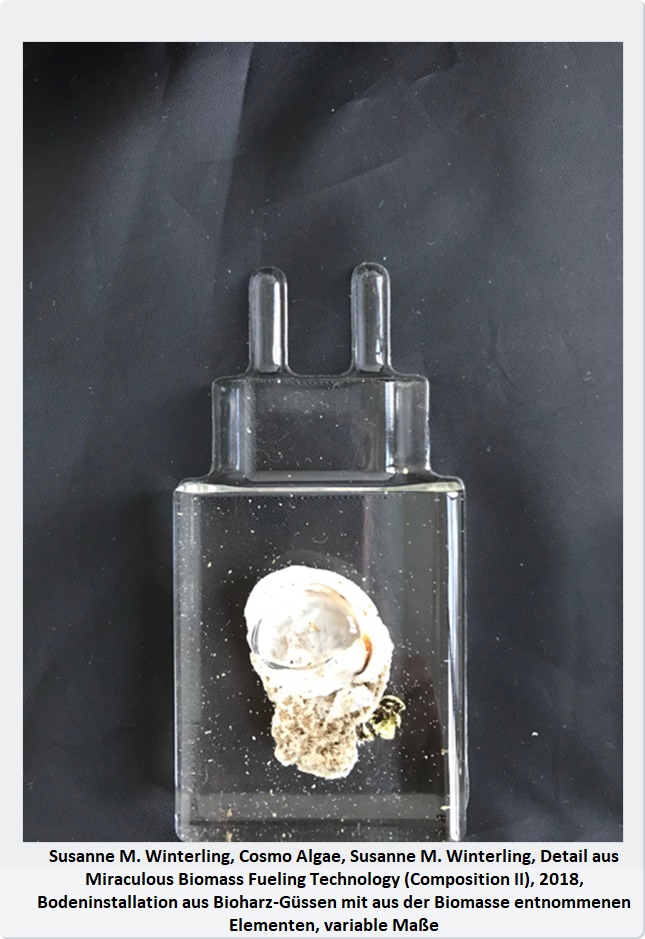
The installation Miraculous Biomass Fueling Technology (Composition I) from 2018, which was first shown at the 2018/2019 Lulea Biennale, consists of a collection of small casts of transparent bio-resin distributed on the floor, their shapes resembling those of specific technological devices. The outlines of a chip card or a power supply can be recognized against the dark background. Enclosed in the resin mass, similar to amber, are various samples of biological life. The material (bio-resin) and the conserved biological matter within stands in a contrast to the form (technical apparatus). In extension, this obvious dualism of biology and technology also refers to the appropriation of natural goods by cultural practices, such as their presentation in natural history museums. The institutional context, and in principle the "system art", are based on methods of selection, as well as categorization and contextualization, which are always characterized by dominant dichotomous discourses following a policy of hierarchical thinking.
Winterling's combination of traditional, magical-emphatic models of explanation and contemporary findings from various fields of science, makes conceptual pairs such as nature and culture, which are based on difference and discrimination, irrelevant. She observes the imbalance in the coexistence of living beings by assuming the perspective of endangered species in order to show the immediate, destructive effects of egocentricity on the so-called “other”. Winterling averts the anthropocentric view – and the concomitant claim to cultural appropriation – dissolving the boundaries between the disciplines and categories in order to question and revise existing power relations. Winterling engages diversity, interdisciplinarity and a plurality of methods, merging biology and ecology with social theory, digital culture and science fiction. In addition, Contrapoints also refers to the Youtube channel, which dissolves the contradictions of physical and gender entities that are referred to as a social "norm" in favor of fluid states and thus is considered a "ray of hope in the raging culture war we find ourselves in." (Winterling)
Progress has long since become a step backwards, especially with regard to intersectionality and politics of the "other". Consequently, some of the works in “Schwerkraft und Atem” (Gravity and Breath) are inspired by marine biologist and poet Rachel Carson as well as science fiction author Octavia Butler.
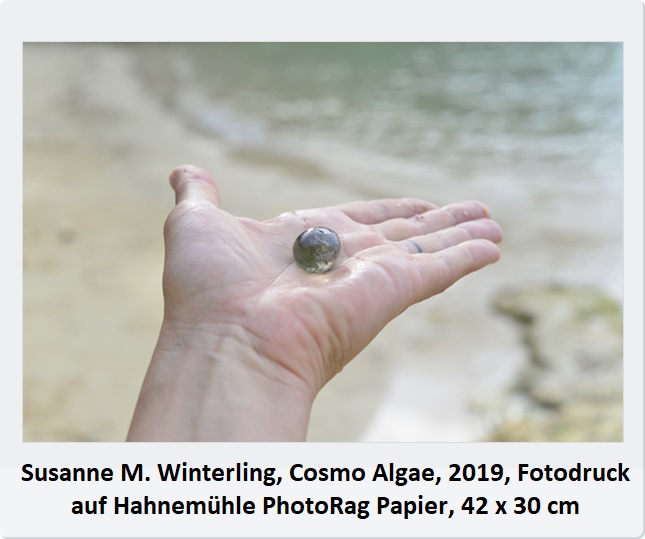
Cosmo Algae (2019) depicts the hand of the artist on whose surface lies a spherical algae. The smooth, wet-glistening surface reflects the immediate surroundings. On closer inspection, the sky and flaky clouds can be recognized, appearing distorted due to the convex curvature. Or are we looking into the complex cell nucleus? Winterling picks up on the artist's interest in science and optical phenomena, and thus joins the tradition of art history, while at the same time expressing an emphatic interest in the material.3 Here, too, the manipulated gaze is implied in the broader context, the susceptibility of perception or limited perspective by the one-sided prescriptions of science and politics.
The materialized merging of microorganisms and humans points to a higher, universal community. To demonstrate this sense of interrelatedness through communication whilst overcoming the essentialization of differences and categorical thinking lies at the center of all works in “Schwerkraft und Atem”. By means of glass and cluster arrangements, a distinct, portrait-like impression is conveyed of the organism constituted by our relationships and the interaction of physical-material existence with social and mental ecology in a reciprocality and dependance that is not time-based.
"The more clearly we can focus our attention on the wonders and realities of the universe around us, the less taste we shall have for destruction."
-Rachel Carson
About the artist:
Susanne Winterling was born in 1970 in Rehau, Upper Franconia, where she lives and works today.
One of the most significant recent exhibitions was Nature after Nature, Friedericianum Kassel (2014), curated by Susanne Pfeffer. Further projects and shows are: Complicity, Kunstverein Amsterdam (NLD) (2014), Myths of the Marble, HOK, Oslo (NOR) und ICA Philadelphia (USA) (2017), An Inventory of Shimmers, MIT List, Boston (USA) (2017), Polyphonic Worlds: Justice as Medium, Contour Biennale, Mechelen (B) (2017), Lulea Biennale (SWE) (2018), Gravitational Currents and the Life Magic, Empty Gallery (HKG) (2018), Barents Spectacle, Kirkenes (NOR) (2019)
Works by the artist are also currently on display in the following exhibitions: Between Bodies am Henry Art Museum, Washington (USA), Leben mit Pflanzen at the Deutsches Hygiene Museum, Dresden, and Suddenly gave the effect of sunlight at Melk Galleri, Oslo (NOR).
1 Sylvia Wynter, The Autopoetic Turn, Human Being as Noun? Or Being Human as Praxis? Towards the Autopoetic Turn/Overturn: A Manifesto
2 These single-celled organisms count more than 100 different species. They ars considered to be algae and, being primary producers of organic substances in the ocean, form the main part of the food pyramid's base. Due to their function in the general cycle of materials, the microorganisms are considered "sensors". They are intelligent indicators of the stability of an ecosystem. Thus, for example, under certain conditions, the algal bloom can be observed as red tide. In some cultures, this emergence was considered a reliable status report, providing information about an unusual increase in temperature or pollution of the sea, reflecting the health or harm of the habitat. During such an acute outbreak, the dinoflagellates excrete toxic substances that, depending on the causative agent, are lethal to many or certain groups of other organisms. Both the red tide and the glowing algae carpets turn out to be an alarm system, a communicative system between species.
3 The employment of such round mirrors, which expand the view, while at the same time shifting proportions and distorting spatial conditions, is common in Winterling's works and can be found in paintings by Jan van Eyck (The Arnolfini Wedding, 1434) and Parmigianino (Selfportrait in the Convex Mirror, 1523), for example.
Contrapoints
“…. the acceleratingly threatening loss of the climatic-ecological habitat conditions, indispensable to our species survival/realization and continued performative enactment as the uniquely auto-instituting, hybrid mode of living being that we are….”
Sylvia Wynter1
In her exhibition “Schwerkraft und Atem” (Gravity and Breath), Susanne M. Winterling shows a series of new works that deal with the changes in our environment and imagination through the exploration of forms, materials and pictorial compositions.
Influenced by sensitive stimulus-response systems which determine signal and information transmission in complex neural, ecological and digital networks while at the same time underlying their susceptibility to interference, Winterling recognizes dynamic relationships between nature, bodies, knowledge, politics, that require an open view, which does not merely evolve around the human being.
The current exhibition, for example, focuses on "biomass": organic materials and forms that stand at the base of life on the planet. Often, microorganisms are the protagonists of Winterling´s works, such as dinoflagellate algae.2 These minute life forms, which appear in multiple forms through photomicrography, computer animation, sculpture, intertwine human and other forms of agency and influence on the biosphere, so that a complex, intricate network of communication is unveiled.
The installation Miraculous Biomass Fueling Technology (Composition I) from 2018, which was first shown at the 2018/2019 Lulea Biennale, consists of a collection of small casts of transparent bio-resin distributed on the floor, their shapes resembling those of specific technological devices. The outlines of a chip card or a power supply can be recognized against the dark background. Enclosed in the resin mass, similar to amber, are various samples of biological life. The material (bio-resin) and the conserved biological matter within stands in a contrast to the form (technical apparatus). In extension, this obvious dualism of biology and technology also refers to the appropriation of natural goods by cultural practices, such as their presentation in natural history museums. The institutional context, and in principle the "system art", are based on methods of selection, as well as categorization and contextualization, which are always characterized by dominant dichotomous discourses following a policy of hierarchical thinking.
Winterling's combination of traditional, magical-emphatic models of explanation and contemporary findings from various fields of science, makes conceptual pairs such as nature and culture, which are based on difference and discrimination, irrelevant. She observes the imbalance in the coexistence of living beings by assuming the perspective of endangered species in order to show the immediate, destructive effects of egocentricity on the so-called “other”. Winterling averts the anthropocentric view – and the concomitant claim to cultural appropriation – dissolving the boundaries between the disciplines and categories in order to question and revise existing power relations. Winterling engages diversity, interdisciplinarity and a plurality of methods, merging biology and ecology with social theory, digital culture and science fiction. In addition, Contrapoints also refers to the Youtube channel, which dissolves the contradictions of physical and gender entities that are referred to as a social "norm" in favor of fluid states and thus is considered a "ray of hope in the raging culture war we find ourselves in." (Winterling)
Progress has long since become a step backwards, especially with regard to intersectionality and politics of the "other". Consequently, some of the works in “Schwerkraft und Atem” (Gravity and Breath) are inspired by marine biologist and poet Rachel Carson as well as science fiction author Octavia Butler.
Cosmo Algae (2019) depicts the hand of the artist on whose surface lies a spherical algae. The smooth, wet-glistening surface reflects the immediate surroundings. On closer inspection, the sky and flaky clouds can be recognized, appearing distorted due to the convex curvature. Or are we looking into the complex cell nucleus? Winterling picks up on the artist's interest in science and optical phenomena, and thus joins the tradition of art history, while at the same time expressing an emphatic interest in the material.3 Here, too, the manipulated gaze is implied in the broader context, the susceptibility of perception or limited perspective by the one-sided prescriptions of science and politics.
The materialized merging of microorganisms and humans points to a higher, universal community. To demonstrate this sense of interrelatedness through communication whilst overcoming the essentialization of differences and categorical thinking lies at the center of all works in “Schwerkraft und Atem”. By means of glass and cluster arrangements, a distinct, portrait-like impression is conveyed of the organism constituted by our relationships and the interaction of physical-material existence with social and mental ecology in a reciprocality and dependance that is not time-based.
"The more clearly we can focus our attention on the wonders and realities of the universe around us, the less taste we shall have for destruction."
-Rachel Carson
About the artist:
Susanne Winterling was born in 1970 in Rehau, Upper Franconia, where she lives and works today.
One of the most significant recent exhibitions was Nature after Nature, Friedericianum Kassel (2014), curated by Susanne Pfeffer. Further projects and shows are: Complicity, Kunstverein Amsterdam (NLD) (2014), Myths of the Marble, HOK, Oslo (NOR) und ICA Philadelphia (USA) (2017), An Inventory of Shimmers, MIT List, Boston (USA) (2017), Polyphonic Worlds: Justice as Medium, Contour Biennale, Mechelen (B) (2017), Lulea Biennale (SWE) (2018), Gravitational Currents and the Life Magic, Empty Gallery (HKG) (2018), Barents Spectacle, Kirkenes (NOR) (2019)
Works by the artist are also currently on display in the following exhibitions: Between Bodies am Henry Art Museum, Washington (USA), Leben mit Pflanzen at the Deutsches Hygiene Museum, Dresden, and Suddenly gave the effect of sunlight at Melk Galleri, Oslo (NOR).
1 Sylvia Wynter, The Autopoetic Turn, Human Being as Noun? Or Being Human as Praxis? Towards the Autopoetic Turn/Overturn: A Manifesto
2 These single-celled organisms count more than 100 different species. They ars considered to be algae and, being primary producers of organic substances in the ocean, form the main part of the food pyramid's base. Due to their function in the general cycle of materials, the microorganisms are considered "sensors". They are intelligent indicators of the stability of an ecosystem. Thus, for example, under certain conditions, the algal bloom can be observed as red tide. In some cultures, this emergence was considered a reliable status report, providing information about an unusual increase in temperature or pollution of the sea, reflecting the health or harm of the habitat. During such an acute outbreak, the dinoflagellates excrete toxic substances that, depending on the causative agent, are lethal to many or certain groups of other organisms. Both the red tide and the glowing algae carpets turn out to be an alarm system, a communicative system between species.
3 The employment of such round mirrors, which expand the view, while at the same time shifting proportions and distorting spatial conditions, is common in Winterling's works and can be found in paintings by Jan van Eyck (The Arnolfini Wedding, 1434) and Parmigianino (Selfportrait in the Convex Mirror, 1523), for example.
 |
Susanne M. Winterling |
OPENING:
FRIDAY, 29. MARCH, 2019, 6 p.m.
mpefm
GERMANY art press release
Hours :
Tuesday to Friday from 11.00 to 18.00 Saturday from 11.00 to 16.00

QR of this press release
in your smartphone, tablet
- Parent Category: press release
- Category: ALL COUNTRIES press release
- Hits: 1358